Most people consider an old, rusted vehicle that is no longer able to get a key-in-start when it finally refuses to start, or a car that is written off after a car accident to be nothing more than a heap. That’s the primary objective: to call a professional tow service such as Southern Towing and Removals, set up an easy pickup time, pick up the cash or document and observe the tow truck drive away down the street. It is the end of the story for the owner of the car.
Meanwhile, the car itself has yet to experience the ride of its life. In today’s automotive world, a junk car is not just dumped in the landfill to rot. If not managed, automotive waste can cause serious environmental problems, but it can also be a vast source of valuable, recyclable materials. Removing a vehicle from the road and converting it to raw, industrial ingredients is a highly regulated and very scientific process.
Phase 1: Initial Intake & Comprehensive Inspection
Once a vehicle reaches a certified processing plant it will be subjected to a thorough examination at the entrance. Not every car is processed the same by wreckers and auto recyclers, each is checked according to the make, model, mechanical status, and structural strength of the vehicle.
In this initial phase, the engineers decide the dual road that the car will take. Conceptually, every vehicle is divided into two parts: salvaged auto parts, and recycled raw materials.
Inventory Cataloging: Technicians record parts that can be sold right away to mechanics, restoration aficionados, or your average motorists seeking a budget replacement part.
Structural Assessment: The structure and body panels are checked to make sure that there is no excessive structural contamination, preparing the shell for the heavy machinery that awaits them later on in the cycle.
Phase 2: Depollution Process (Protecting Our Ecosystem)
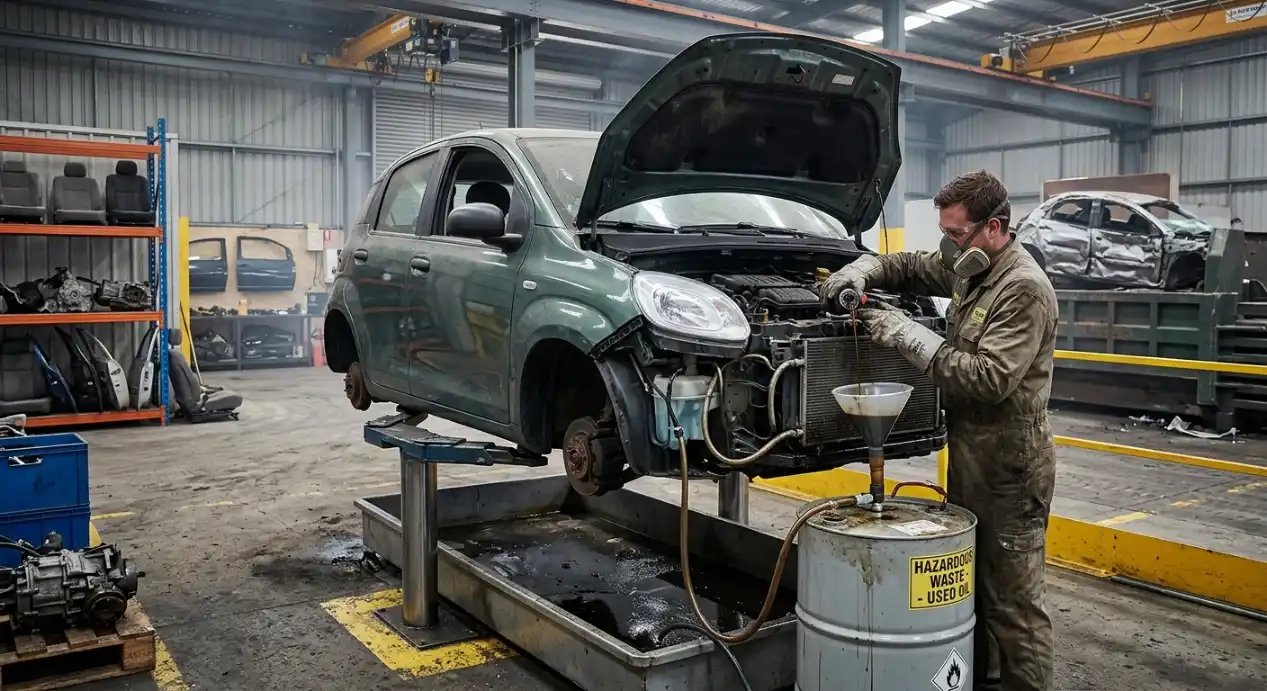
The depollution phase is the most critical one in the whole trip concerning the environment. Today’s cars use a variety of very sophisticated and poisonous chemical fluids to lubricate engines, cool combustion chambers, increase the braking force, and wash away windshield fog. These chemicals can leach directly into the topsoil if the junk car is left to rot in a field, or to be crushed and not depolluted, contaminating local ground water tables and poisoning local wildlife habitats.
Certified vehicle removal and recycling centers have their own depollution bays, which feature specially designed vacuum extraction systems, overhead drainage rigs, and heavy duty containment units to safely extract the car’s liquids.
Engine & Transmission Oils
During a vehicle’s operating life, motor and transmission fluids are exposed to high heat (about 300 degrees) and high pressure (up to 10,000 psi) and accumulate heavy metals and chemicals. These fluids are carefully pumped from and into double-walled storage tanks. After collection they are transported to special refineries for re-refining. This removes impurities, thus returning dirty oil to a high quality base stock for a new lubricant.
Coolants and Antifreeze
Antifreeze is composed of a sweet tasting, but extremely toxic, chemical called ethylene glycol that can be fatal to humans and animals if it is ingested, even in small amounts, by animals or humans exposed to it in the water supply. Recyclers collect all of the coolant, which is filtered and distilled so the chemical compounds can be safely re-used in the industrial manufacturing process or new auto products.
This section examines the various types of air conditioning refrigerant gases:
HFCs (hydrofluorocarbons) or CFCs (chlorofluorocarbons) are chemicals that are sometimes used in older vehicles’ air conditioning systems. These gases are very potent greenhouse gases, and if released to the atmosphere they will cause significant destruction of the ozone layer. Closed-loop recovery units are employed to safely remove the gas under negative pressure from the area and collect it in heavy cylinders, where it can be chemically recovered or destroyed.
How to Store Batteries and Heavy Metals.
The automotive lead acid battery is extremely poisonous, yet has an amazing recycling history. A standard car battery can be recycled almost to its full capacity of nearly 99%. The plastic shell is ground into plastic pellets to create new battery shells, the acid from the batteries is neutralized or transformed into an industrial grade of sodium sulfate (table salt), and the lead plates are melted down to make new batteries.
Phase 3: Recovering Recyclable Parts For The Circular Economy
The principles of a circular economy; minimising waste by using and reusing resources over time are key to true environmental sustainability. After all liquids are removed from a car, it is time for mechanical disassembly. Reducing, reusing, and recycling a car component is a huge use of fossil fuels, electricity and mined raw materials when compared to building an entirely new car part. The automotive industry can significantly reduce its industry-wide carbon footprint by harvesting, cleaning and reusing working components from end-of-life vehicles.
High-Value Mechanical Parts
Some components are carefully removed, such as a starter motor, alternator, water pump, steering rack, and a complete transmission. They are tested, catalogued and kept in warehouse stocks. In many cases, these parts can be marketed as “remanufactured” parts, and car owners can get a cheap, environmentally friendly replacement for brand new factory parts.
Catalytic Converter Goldmine.
As mentioned in the scrap valuation guides, the catalytic converter is an asset that is important to the environment, even when it is destroyed. These parts have very low levels of extremely uncommon, precious metals such as platinum, palladium and rhodium. These metals are smelted from the dust generated by the crushing of the inner ceramic honeycombs of the converter, which are performed at special recycling facilities in industrial methods. The recovered platinum and palladium are then fed directly back into the production process to produce new emission control equipment for the modern, clean vehicles.
Wheels & Tires
Immediately, aluminum alloy wheels are unbolted and sorted. Wheels are a high priority product for smelters because it takes only about 95% of the energy to recycle aluminum than to make it from raw bauxite ore. Tires are especially problematic to recycle because, if left in large stockpiles on the ground, they can create very serious fire risks. New tires are commonly ground into “crumb rubber” and utilized in playground flooring for shock absorption, rubberized asphalt for smoother roads and as sports turf infill.
After fluids have been completely removed and the interior electronics, wiring harnesses, high dollar parts and heavy mechanical systems are removed, the vehicle is left with just the shell. A shell made of ferrous metal (iron and steel) is its main material.
The Auto Crusher
For efficient transportation, the vehicle shell is directed to a hydraulic car crush that transforms the car into a cube-shaped pile of steel.The vehicle shell is transported efficiently by being fed into a hydraulic car crush, which crushes the car into a steel cube. The machine is subjected to a high-pressure situation, flattening the vehicle into a small piece of metal block or slab. This allows dozens of vehicle chassis to be sent all at once to a regional industrial shredding plant on a flatbed transport vehicle.
The Industrial Shredder
The car chassis will be compressed at the shredding plant and then fed into a large (several megawatts) industrial shredder. In just seconds, the spinning hammers start shredding the vehicle shell into chunks of metal, plastic and glass, the size of fists.
Magnetic Separation and Flotation
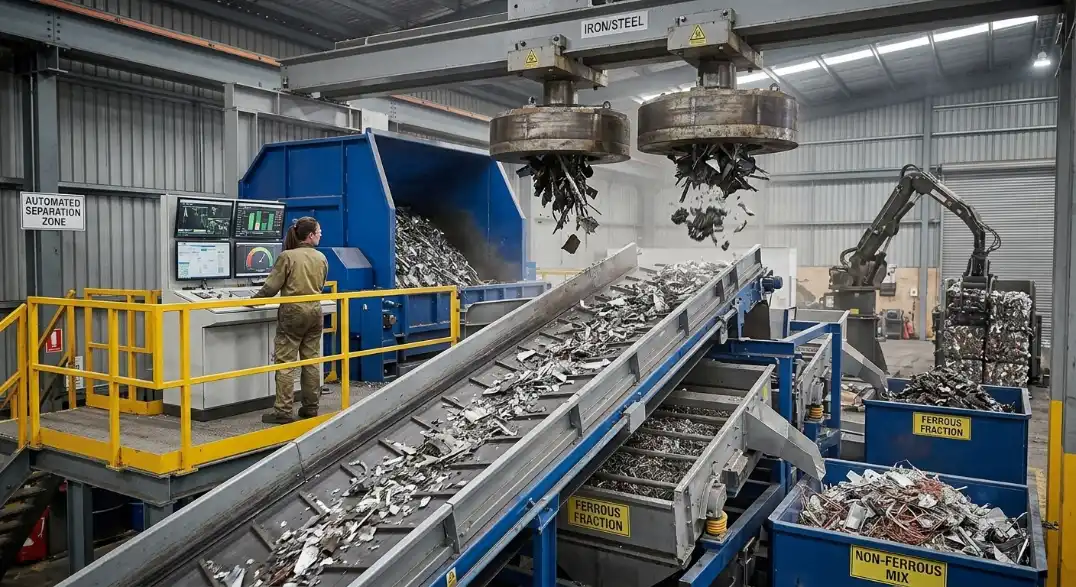
The shredded mix is fed into a high-powered industrial magnet system under a conveyor belt moving at high speeds. All steel and iron based materials (ferrous metals) are instantaneously separated from non-magnetic materials, due to the power of the magnets, as they are pulled off the belt.
Sent directly to electric arc furnaces where they are melted down at high temperatures and re-cast into new steel beams, rebar, sheet metal and industrial piping.
Non-Ferrous Metals: Copper and residual aluminum materials are separated with eddy current system and advanced air-flotation tank, so that no valuable metal is wasted.
Historically, the residual product of glass, plastics and fabrics is commonly dumped in landfills, but the introduction of optical scanning technologies to sort this waste stream is rapidly moving towards a zero waste solution: Automotive Shredder Residue (ASR).
Green Legacy is Professional Car Removal
Whenever a car is driven off the lot at Southern Towing and Removals it helps to conserve the world. Scrap steel recycling alone could save millions of barrels of crude oil, thousands of tons of iron ore and huge savings of coal energy annually.
Professional car removal services are not just a triumph in the fight against visual clutter, they are a force for good in our world’s environment as all the parts and panels that can be used are recycled back into the production line and all the toxic fluids are permanently removed from our soil.