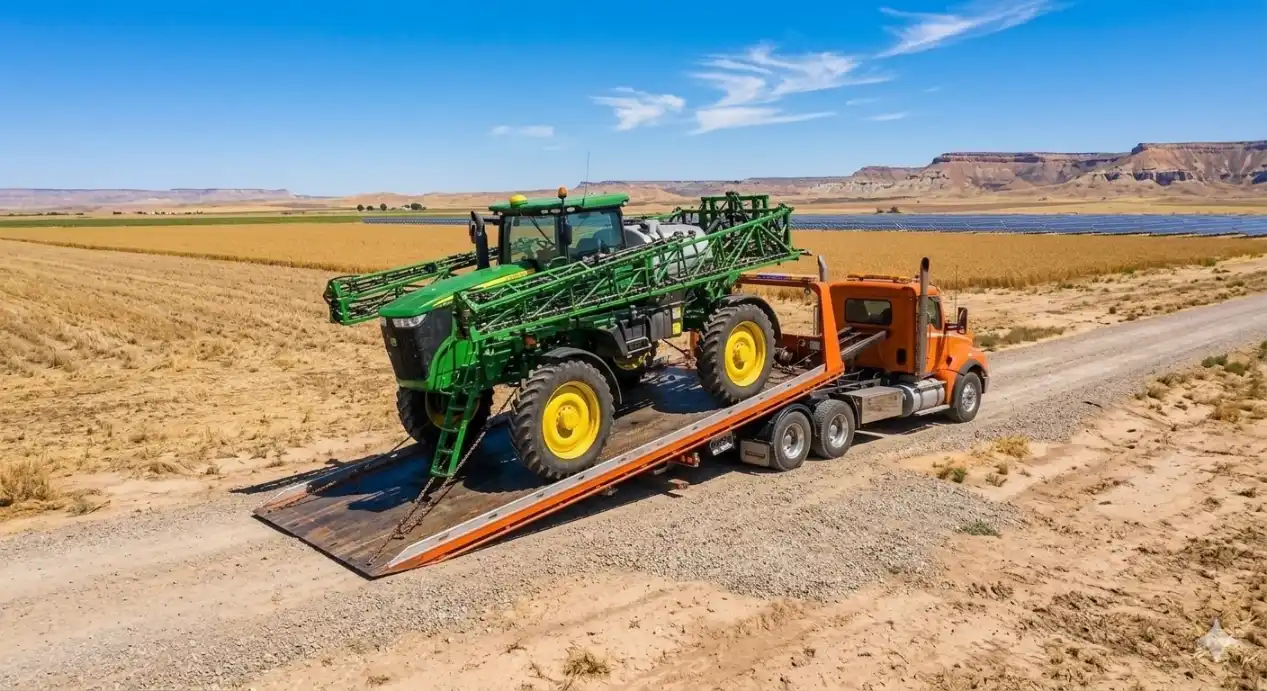
When it comes to transporting heavy equipment safely, moving the Fleet means having a workforce of local farms and contractors ready to roll. Whether it’s a large John Deere combine harvesting in Georgia or a Caterpillar excavator paving a foundation in Mississippi, heavy equipment is the backbone of the industry in the South. Moving these multi-tonne assets from one job site or field to another, however, is a huge logistical challenge. Many operators are tempted to try to do the heavy equipment transport themselves.
They tow a giant skid steer on an underpowered utility trailer, or they tow a slow tractor on a high-speed state highway. The shortcuts leave immediate and great dangers. Incorrectly moving industrial and agricultural machinery can result in catastrophic damage to the trailer structure, massive fines for highway safety and permanent damage to the equipment. If you must move your fleet, you’ll find that weight distribution, state requirements, and specialty industrial transport are extremely specific, and you’ll see why moving your own is a bad idea, and why moving your fleet with professional transport is your only safe bet.
Behind-the-Scenes of Transporting Industrial Vehicles
Transporting industrial machinery is very different to consumer vehicle transport, and is subject to several complexities. Heavy equipment is characterized by irregular shapes, very uneven weight distribution, and high physical density.
A regular vehicle has a fairly even weight distribution. A piece of heavy equipment does not. A skid steer has a massive amount of its weight in the back of its engine bay as opposed to an excavator, which puts its weight in its tracks and a heavy hydraulic boom.
Too far forward: This increases the amount of tongue weight on the hitch of the truck, loading the rear suspension, lifting the front steering tires and taking all braking control.
Away from the rear: This results in rear end sway. A tail heavy trailer will start to fish tail and can easily turn the trailer and tow truck over at highway speeds. For each trailer, truck axle and hitch receiver there is a strict Gross Vehicle Weight Rating (GVWR).
Often, the DIY haulers don’t pay attention to such restrictions, thinking that a trailer can carry “just a little more weight” for a short distance. When the load is high, structural failures happen fast and fast; tires blow under extreme pressure, frames warp or break under load, and truck brakes overheat and stop all together on steep hills.
Mindful of Southern Transport Laws
The transportation of heavy vehicles down public roads is tightly controlled in the South by the Department of Transportation (DOT). Not only will there be a risk of mechanical damage, there will also be a huge risk of liability under the Commercial Court system and thousands of dollars in fines.
Oversize and Overweight Permits: There are size and weight limits beyond the legal size (8.5 feet) and weight of many large agricultural machinery, wide tractors, and heavy excavators. These assets must be transported with specific state permits, carefully planned routes (to avoid low clearance bridges), and certified escort vehicles to alert oncoming traffic. Your heavy equipment is considered to be a commercial motor vehicle (CMV) when you are moving it for commercial purposes.
Your heavy equipment will be classified as a commercial motor vehicle (CMV) if used for a commercial purpose. This includes drivers having to follow very specific federal guidelines: Hours Of Service (HOS) tracking, keeping current medical cards, and even random roadside weight checks.
The Federal Motor Carrier Safety Administration (FMCSA) has very specific cargo securement requirements. Heavy-duty equipment weighing more than 10,000 pounds shall be securely tied down with at least four chains, each of which shall be heavy-duty and directly connected to a tie-down point on the machine frame. Trapping a cheap strap around a hydraulic arm or an attachment bucket is prohibited, and police will immediately shut down the roadside.
The Professional Alternative: Specialized Heavy-Duty Transport Services
Commercial Transport is a risky endeavor and should only be performed by a specialized heavy duty recovery and towing company because you, your business and the public are all at risk unless you have the appropriate equipment and knowledge.
Professional transport operations don’t count on guesswork or a typical utility trailer. Rather, they have specific fleet equipment designed for industrial loads. For professional heavy-duty haulers, lowboy (RGN) trailers and step-deck trailers are special types of trailers.
A lowboy trailer is just inches above the asphalt. This low profile allows taller excavators and large agricultural tractors to pass safely and without incident through low-clearance utility lines and highway bridges without the need to weave at an angle or bend. The loading of a broken-down or non-operational machine onto a normal trailer is a hazardous and steep challenge.
The professional trailers include fully hydraulic loading ramps or removable goosenecks (RGN). The front hitch section is fully removable on an RGN trailer, where the front of the trailer can collapse flat to the ground. This makes it a very safe, extremely low-angle ramp to have the heaviest tracked machine drive straight up the ramp without a problem.
The trained load calculation professionals are certified rigging and load distribution professionals. They inspect your machine’s specific center of gravity, calculate the exact location on the trailer deck for your machine, and secure it with Grade-70 transport chains. This makes the entire loading process totally loss-free.
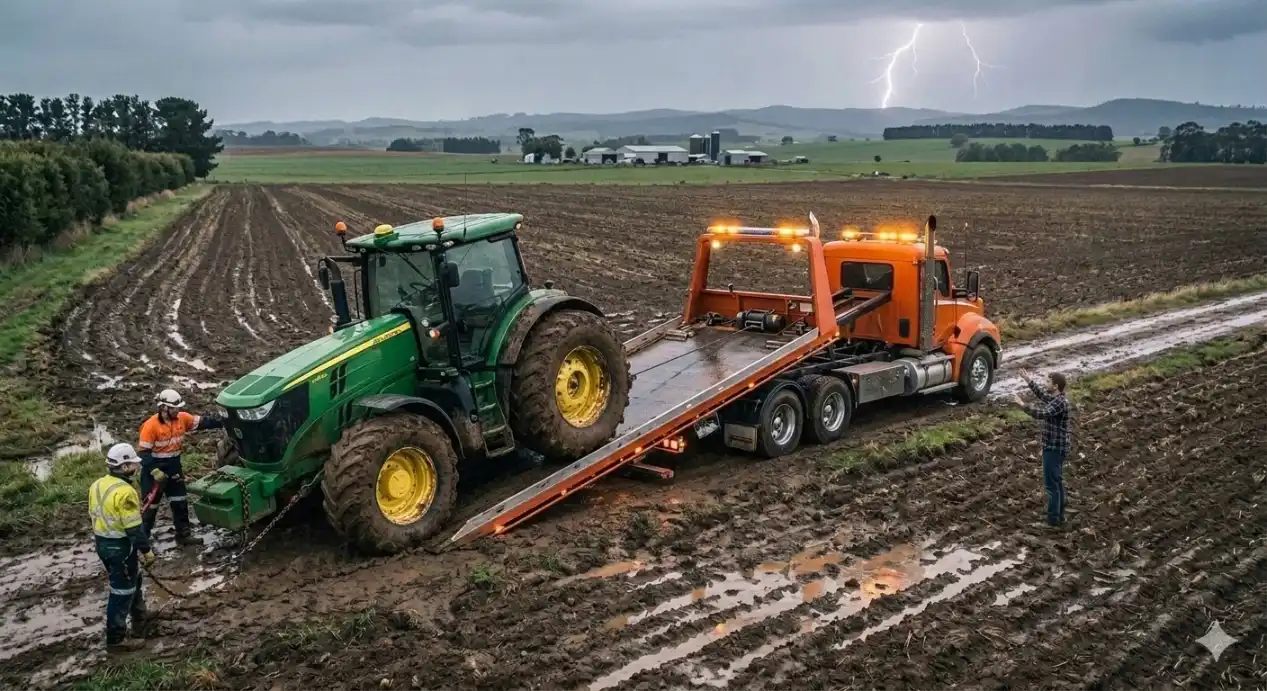
Various Farming Vehicles & The Underlying Challenges
There are a variety of different sizes and shapes of machinery used in agricultural production. Farms can have very wide vehicles and hefty and/or extremely under-slung machines that are exceptionally fragile and require extra care. Taking them with you calls for picking the appropriate type of heavy-duty trailer.
Most popular farm machinery requiring special transport services are:
Combine Harvesters: These are the largest machines on the farm. They are very heavy to load with their huge grain tanks and wide footprints, and are almost always transported on oversize permits and on low-boy trucks.
Row-Crop Tractors: Large four-wheel-drive dual-tire tractors are too wide for standard lanes. They frequently have to be loaded on a roll-off trailer or have the outer wheels lifted, so they can be transported.
The dense skid steer and track loader are essential for handling feed and barn cleaning and have a very concentrated center of gravity, which can cause a light utility trailer to sway or “fishtail” at highway speed.
Hay Balers and Wrappers: These typically would be pulled in the field behind a tractor but would need to be safely picked up by their delicate mechanical tines and internal belts in the field with a flatbed deck over great distances on a highway.
Sprayers and Spreaders: The chemical sprayers are self-propelled and have long, fragile boom arms and high ground clearance. They have to be carefully rigged and arranged so that the booms don’t unwrap or get snagged on low bridges when they are being conveyed. There’s a lot of commercial livelihood that depends on your heavy machinery, which is the backbone of your commercial livelihood.
From transporting a tractor from county to county during the harvest season to moving a whole construction crew to a different development site, neither moving jobs nor moving safety should be taken lightly.
Don’t get lured into taking a chance on a non-permitted project that may lead to a flipped trailer, crushed machine, or a huge DOT fine. Play smart, safeguard your business investments, and reach out to a professional, heavy-duty hauling firm to safely and efficiently move your fleet.
Get an upfront quote from Southern Towing & Removals